
(Estimated reading time: 10 minutes)
Nursing is one of the most diverse fields in healthcare. It offers countless opportunities for career growth and specialization. Are you considering a career in nursing or want to understand different types of nurses in healthcare settings?
This guide will explain the different nursing roles and their salaries in the United States. You’ll also discover the unique specialties and paths available in modern healthcare settings.
Basic Nursing Roles
When we look at it from a patient’s perspective, we will assume that there is only one type of nurse. However, depending on the specialization, there are different types of nurses. Here are the different types of nurses:
Licensed Practical Nurses (LPN)
Average Annual Salary for LPN and LVN in the US: $ 60,790 per year
Source: United States Bureau of Labor Statistics (May 2023)
Licensed Practical Nurses, also known as Licensed Vocational Nurses (LVNs) in some states, represent the entry level of nursing practice. These professionals provide basic nursing care under the supervision of registered nurses and physicians. Their duties typically include:
- Taking vital signs
- Administering basic medications
- Helping patients with daily activities
- Maintaining patient records
- Providing basic wound care
Educational Requirements:
- Diploma or certificate from an accredited practical nursing program
- Program length: 12-18 months
- Must pass the NCLEX-PN examination
- Continuing education requirements vary by state
Registered Nurses (RN)
Average Annual Salary for RN in the US: $ 80,321 per year
Source: ZipRecruiter
Registered Nurses form the backbone of the healthcare system. With experience and specialization, these types of nurses can earn upwards of $120,000 annually, particularly in high-cost urban areas or specialized units. Their responsibilities include:
- Developing and implementing patient care plans
- Administering medications and treatments
- Coordinating with healthcare team members
- Educating patients and families
- Supervising LPNs and nursing assistants
Educational Requirements:
- Associate Degree in Nursing (ADN): 2-3 years or
- Bachelor of Science in Nursing (BSN): 4 years
- Must pass the NCLEX-RN examination
- Many employers prefer or require a BSN
Different Specialized Nursing Roles
Beyond the essential nursing roles, different types of specialized nurses require additional training and expertise. These specialized nurses focus on specific patient populations or healthcare settings and often command higher salaries due to their advanced skills.
Critical Care Nurses (CCN)
Average Annual Salary for CCN in the US: $86,982 per year
Source: Payscale
Critical care nurses work in intensive care units (ICUs) and specialize in treating patients with life-threatening conditions. Moreover, critical care nurses often earn higher salaries due to the demanding nature of their work and the additional certifications required. These highly skilled professionals must:
- Monitor complex medical equipment
- Respond quickly to changes in patient condition
- Manage multiple life-support systems
- Provide specialized care for critically ill patients
Educational Requirements:
- BSN preferred
- Additional certifications:
- Critical Care Registered Nurse (CCRN)
- Required clinical experience: 1,750-2,000 hours in critical care
Emergency Room Nurses
Average Annual Salary for ER Nurses in the US: $86,737 per year
Source: ZipRecruiter
ER nurses can earn premium pay due to the high-stress environment and need for extensive trauma care experience. Additionally, ER nurses work in fast-paced emergency departments, where they must:
- Quickly assess patient conditions
- Prioritize care based on severity
- Handle trauma cases
- Coordinate with emergency response teams
Educational Requirements:
- BSN preferred
- Certifications:
- Certified Emergency Nurse (CEN)
- Trauma Nursing Core Course (TNCC)
- Minimum 2 years of ER experience for certification
Operating Room Nurses
Average Annual Salary for OR Nurses in the US: $94,573 per year
Source: ZipRecruiter
Also known as perioperative nurses, these type of nurses work before, during, and after surgical procedures. Perioperative nurses often earn higher salaries due to their specialized skills and the technical nature of their work. Their responsibilities include:
- Preparing operating rooms
- Assisting surgeons
- Managing surgical equipment
- Monitoring patients during surgery
- Coordinating post-operative care
Educational Requirements:
- BSN preferred
- Certification:
- CNOR (Certified Perioperative Nurse)
- Required: 2 years and 2,400 hours of perioperative experience
Pediatric Nurses
Average Annual Salary for Pedia Nurses in the US: $89,855 per year
Source: Glassdoor
Pediatric nurses specialize in caring for children from infancy through adolescence. In addition, pediatric nurses’ salaries can vary based on their setting (hospital vs. clinic) and additional certifications. They must:
- Understand developmental stages
- Communicate effectively with children and parents
- Provide age-appropriate care
- Recognize pediatric-specific health conditions
Educational Requirements:
- BSN preferred
- Certification:
- Certified Pediatric Nurse (CPN)
- Required: 1,800 hours of pediatric nursing experience
Psychiatric Nurses
Average Annual Salary for Psychiatric Nurses in the US: $98,220 per year
Source: United States Bureau of Labor Statistics (May 2023)
Mental health nurses may earn additional compensation for working in high-risk environments or obtaining specialized certifications. Moreover, mental health nurses work with patients experiencing psychological and emotional disorders. Their duties include:
- Conducting mental health assessments
- Administering psychiatric medications
- Providing therapeutic support
- Managing crises
Educational Requirements:
- BSN preferred
- Certification:
- Psychiatric-Mental Health Nursing Certification (PMH-BC)
- Required: 2 years of practice in psychiatric nursing
Different Advanced Practice Nursing Roles
APRNs have completed additional education beyond their RN qualification, typically holding at least a master’s degree. These types of nurses can often practice independently and have prescriptive authority in many states. Their higher education and expanded scope of practice command significantly higher salaries.
Nurse Practitioners
Average Annual Salary for NPs in the US: $128,490 per year
Source: United States Bureau of Labor Statistics (May 2023)
Nurse Practitioners (NPs) often earn the highest salaries among nursing professionals, particularly those in private practice or specialized fields. NPs provide primary and specialty care, often functioning similarly to physicians. They can:
- Diagnose and treat illnesses
- Prescribe medications
- Order and interpret diagnostic tests
- Provide preventive care services
Educational Requirements:
- MSN or DNP required
- Total education: 6-8 years
- Specialty certification in chosen areas (family, pediatric, etc.)
- Minimum 500 clinical hours in the specialty
Clinical Nurse Specialists
Average Annual Salary for Clinical Nurse in the US: $125,900 per year
Source: Glassdoor
These expert nurses focus on specific patient populations or medical specialties. They often:
- Serve as consultants
- Implement evidence-based practices
- Improve patient care systems
- Train other nursing staff
Educational Requirements:
- MSN or DNP required
- Total education: 6-8 years
- Specialty certification required
- Minimum 500 clinical hours in the specialty area
Nurse Anesthetists
Average Annual Salary for CCN in the US: $212,650 per year
Source: American Association of Nurse Anesthesiology
Certified Registered Nurse Anesthetists (CRNAs) specialize in administering anesthesia. CRNAs are typically the highest-paid nursing professionals, with some experienced practitioners earning over $250,000 annually.
These experts command higher salaries due to their advanced education and leadership roles. Their responsibilities include:
- Evaluating patients before surgery
- Administering and monitoring anesthesia
- Managing pain control
- Overseeing post-anesthesia recovery
Educational Requirements:
- Doctor of Nursing Practice (DNP)
- Total education: 7-8 years
- Minimum 1-year critical care experience before CRNA program
- 2,000+ clinical hours during the program
Nurse Midwives
Mean Annual Salary for Nurse Midwives in the US: $131,570 per year
Source: United States Bureau of Labor Statistics (May 2023)
Certified Nurse Midwives earn competitive salaries, particularly in private practice or urban settings. Moreover, Certified Nurse Midwives provide comprehensive care for women, including:
- Prenatal Care
- Labor and Delivery Services
- Postpartum Care
- General Women’s Health Services
Educational Requirements:
- MSN or DNP required
- Total education: 6-8 years
- Certification through the American Midwifery Certification Board
- Minimum 600-1,000 clinical hours
Different Emerging Nursing Roles
Different nursing roles have emerged in the rapidly evolving healthcare landscape to address technological advancements, workforce demands, and research needs. This is in line with the integration of AI and modern technology. In addition, these specialized roles offer competitive salaries and unique career paths for nurses seeking growth and impact.
Informatics Nurses
Mean Annual Salary for Informatics Nurses in the US: $98,409 per year
Source: ZipRecruiter
By acting as a liaison between nursing and technology, these specialists justify their higher pay with their specialized knowledge. These specialists bridge the gap between nursing and technology by:
- Managing healthcare information systems
- Training staff on new technologies
- Improving electronic health records
- Analyzing healthcare data
Educational Requirements:
- BSN required, MSN preferred
- Additional certification:
- Nursing Informatics certification
- Required: 2,000 hours of informatics practice
Travel Nurses
Mean Annual Salary for Travel Nurses in the US: $101,132 per year
Source: ZipRecruiter
Travel nurses are the types of nurses who often earn premium pay plus housing and travel allowances, with crisis assignments paying significantly more. Additionally, travel nurses fill temporary positions at healthcare facilities nationwide. They must:
- Adapt quickly to new environments
- Master different hospital systems
- Provide consistent care across settings
- Handle diverse patient populations
Educational Requirements:
- BSN preferred
- Minimum 1-2 years experience in specialty area
- Multiple state licenses or compact license
- Specialty certifications based on assignment
Clinical Research Nurses (CRN)
Mean Annual Salary for CRN in the US: $113,102 per year
Source: United States Bureau of Labor Statistics (May 2023)
Clinical research nurses’ salaries vary widely based on the research setting and funding source. In addition, clinical research nurses contribute to medical advancement by:
- Conducting clinical trials
- Collecting and analyzing data
- Ensuring research protocol compliance
- Protecting patient safety in studies
Educational Requirements:
- BSN required, MSN or PhD preferred
- Certification:
- Clinical Research Nursing certification
- Required: 2 years research experience
Be A Registered International Nurse through IPASS!
Are you dreaming of working as a registered nurse in prestigious healthcare facilities across developed nations worldwide? IPASS has helped thousands of nurses secure their registration in the US, Canada, Australia, New Zealand, the UK, Ireland, and the Middle East.
IPASS Processing is a company that helps medical professionals, primarily nurses, who want to work abroad. We understand that different types of nurses have unique career goals and specializations. We offer a range of services to assist with the complex process of international licensure. Here’s a breakdown of our key services:
- IPASS Processing assists with the application process for various international licensure exams, including:
- NCLEX (USA, Canada, Australia)
- UK-NMC (United Kingdom)
- Licensure exams for the Middle East (DOH, DHA, MOPH, etc.)
- OPRA (Formerly known as KAPS Australia)
- Credentialing and Eligibility
- IPASS helps with credential evaluation, ensuring your qualifications meet the requirements of the target country
- Assistance with obtaining eligibility numbers needed for exams
- Other Application Assistance
- VisaScreen applications
- License endorsement and renewal
- PRC processes (for Filipino professionals)
- Tourist visa applications (for Australia)
- IPASS also offers a Next Generation NCLEX review program to help nurses prepare for the exam. This includes:
- Online classes and resources
- Practice questions and assessments
- One-on-one coaching
- Additional Services:
- Criminal Background Checks
- Dataflow Processing Assistance
- Document Verification
- For a complete list of services, please visit our services page.
Our almost decade-long experience has guided thousands of healthcare professionals toward their international nursing dreams. Trust our proven expertise to navigate the complex registration process for your nursing career abroad.
Contact us now and let IPASS help you make your dream international nursing career a reality!
Conclusion
The nursing profession offers different types of nurses that match different skills, interests, and healthcare specialties. Entry-level roles build strong foundations, while advanced positions provide greater autonomy and higher salaries. Technological advancements continue creating new specialties, expanding career growth and development opportunities in this evolving field.
Nurses serve as the backbone of healthcare, enjoying job security and deep personal fulfillment. BSN degrees and certifications improve career prospects and increase earning potential over time. Many nurses switch specialties, using transferable skills to explore different healthcare settings. Shadowing professionals can help you discover the perfect nursing path.
Your nursing career will be a powerful force for healing, transforming lives during their most vulnerable moments. No matter the specialty you select, may this fulfill you with purpose and the chance to make a difference every day.
Frequently Asked Questions
- What’s the difference between an LPN and an RN?
LPNs play a vital role in healthcare and can start their careers quickly, typically completing their training in just 12 to 18 months. RNs complete more extensive education in two to four years and have broader responsibilities in patient care and medical decision-making.
- How long does it take to become a Nurse Practitioner?
Becoming a Nurse Practitioner requires about 6-8 years of education: 4 years for a BSN, plus 2-4 years for a master’s or doctoral degree.
- Can nurses change specialties during their careers?
Yes, nurses can change specialties throughout their careers by obtaining additional certifications and training in their areas of interest.
- What is the highest level of nursing?
The highest level of nursing is typically considered a Doctor of Nursing Practice (DNP) or Ph.D. in Nursing.
- Are there specialized certifications for different types of nurses?
Yes, most nursing specialties have specific certification programs that nurses can complete to demonstrate expertise in their field.
- How do nursing salaries vary by location?
Nursing salaries can vary significantly by location. For instance, nurses in urban areas and states like California, New York, and Massachusetts typically earn 20-40% more than the national average. However, these areas often have a higher cost of living.
(Estimated Reading Time: 13 minutes)
Our 20th cycle marks another exciting chapter in helping nurses prepare confidently for the NCLEX. This holiday season, as twinkling lights and festive cheer fill the air, we’re thrilled to bring you something truly special. Over the years, thousands have trusted IPASS for clear guidance, supportive coaching, and a structured review that makes a real difference. And this new cycle is built to be our most refined and student-focused yet.
If you’re ready to step into a review program designed to simplify your journey, strengthen your foundation, and guide you every step of the way, you’ll want to see what we’ve prepared for this milestone cycle. As we open our 20th cycle, we’re doing more than launching a new batch. We’re opening the doors to a proven system that has shaped the success stories of countless passers, and this Christmas, we invite you to start your own success story.
Read on and discover what makes the 20th cycle our strongest one yet, and unwrap the opportunity to prepare, succeed, and shine in the year ahead.
Why Taking the NCLEX Can Transform Your Nursing Career
The NCLEX is the exam that proves you’re ready to practice safely as a professional nurse. It exists because every nurse must demonstrate essential knowledge, skills, and clinical judgment to protect patients. Passing it grants you the privilege to become a licensed Registered Nurse in major destinations like the United States, and your results are also recognized in Canada and Australia through their regulatory pathways. Several other countries consider NCLEX a strong indicator of competence, which may support applications or even allow exam exemptions depending on their requirements.
Simply put: you take the NCLEX because it is the global standard of nursing readiness, a trusted, legally recognized measure that shows you can deliver safe and effective care as an entry-level nurse.
Understanding the IPASS 20th Cycle Next-Gen NCLEX Review Program
As IPASS enters its 20th Review Cycle, we’re building on years of successful training while introducing smarter, stronger, and more learner-centered innovations. This cycle marks a new chapter in how internationally educated nurses prepare for the NCLEX, a program designed not just to help you pass, but to elevate your competence and confidence for global practice.
Unlike traditional review styles that focus heavily on memorization, our 20th Cycle brings a deeper, more adaptive learning experience, one that mirrors today’s fast-changing healthcare environments and the demands of the Next-Gen NCLEX.
1) Our Evolving Approach to Nurse Readiness
For the 20th cycle, IPASS strengthens its commitment to shaping nurses who can think independently, reason clinically, and solve problems under pressure. Instead of repeating last cycle’s methods, we’ve refined our teaching model to emphasize:
- Smarter clinical reasoning, grounded in real-world cases
- Active learning strategies tailored for adult learners
- Decision-making frameworks aligned with the evolving NCLEX test plan
This cycle continues our mission of helping nurses pass on their first attempt, while enhancing your long-term competence so you can succeed not only on exam day but in every clinical setting thereafter.
2) A Program Anchored in Trusted Standards
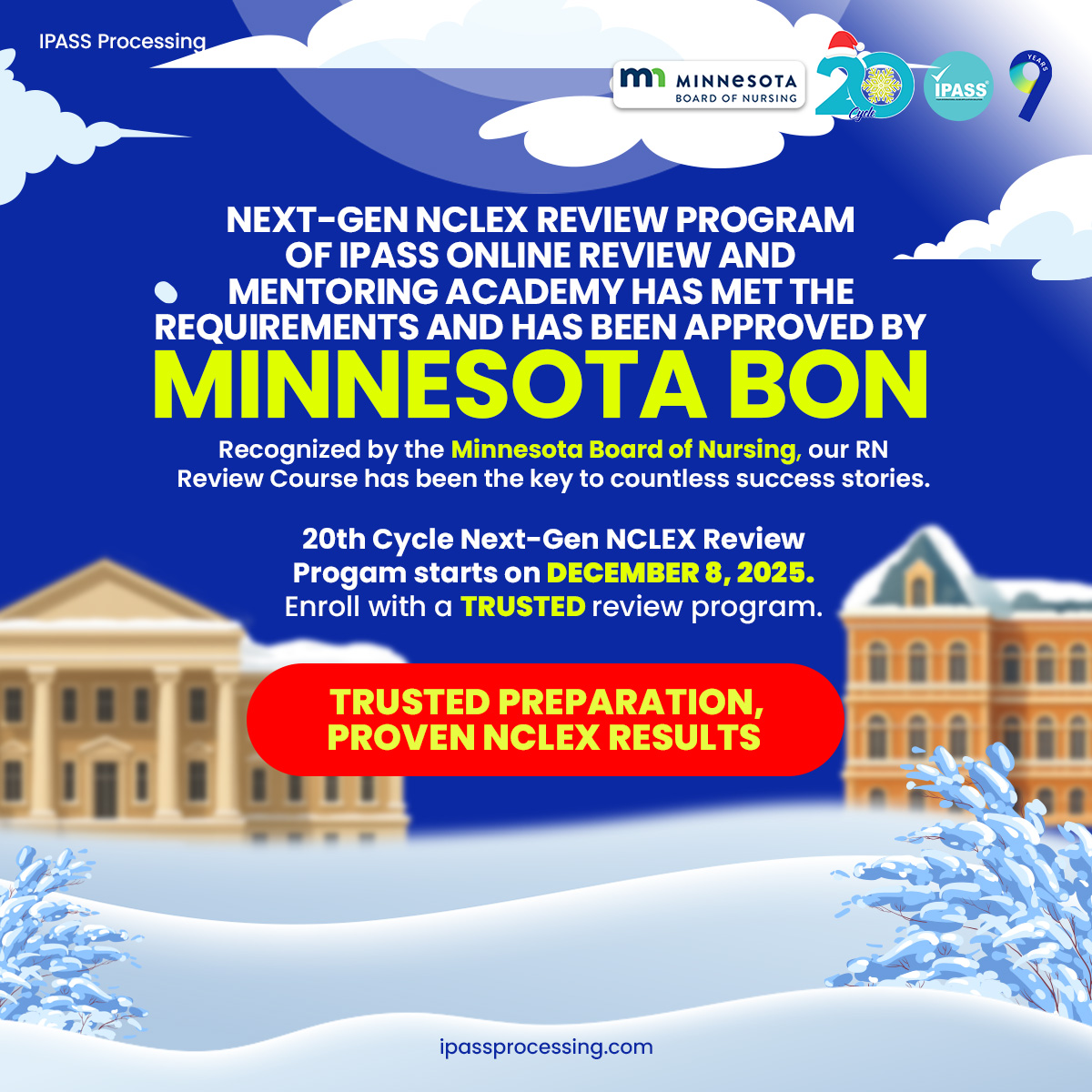
IPASS maintains its recognition by the Minnesota Board of Nursing, ensuring that every lecture, module, and assessment remains aligned with U.S. nursing regulatory expectations.
For the 20th cycle, we leveraged this recognition to continuously improve our materials ensuring your review is shaped by standards that uphold patient safety, professional accountability, and global nursing excellence.
3) Integrated Smart Learning Tools for 2025
While our previous cycle introduced strong analytics and scenario-based questions, the 20th cycle enhances this further with:
- Improved Next-Gen case simulations
- More intuitive performance dashboards
- Adaptive practice sets that adjust to your knowledge level
- Streamlined mobile access for busy nurses on shifting schedules
These tools allow you to study efficiently and intentionally—focusing your efforts where they matter most.
4) A Curriculum That Moves With the Global Nursing Landscape
Healthcare evolves and so does the NCLEX.
In our 20th cycle, we’ve refined and expanded our curriculum to reflect:
- The latest NCLEX-RN Test Plan
- Emerging practice trends across the U.S., Canada, and Australia
- Common weaknesses identified from previous cycles
- More updated rationales and case explanations
- Enhanced coaching strategies for internationally educated nurses
And as always, our educators bring firsthand experience from U.S., Canadian, and Australian healthcare systems ensuring your learning stays relevant and practice-ready
IPASS 19th Your 20th Cycle NCLEX Online Review: Month-by-Month Roadmap to SuccessNCLEX Review Program Structure and Timeline
At IPASS, we know that preparing for the NCLEX can feel overwhelming but it doesn’t have to be. Our 20th Cycle NCLEX Online Review is carefully designed to guide you step by step, ensuring you gain the knowledge, skills, and confidence you need to succeed. Here’s a friendly month-by-month look at what you can expect:
December 2025: Foundation and Orientation Month
Setting the Groundwork for NCLEX Success
We start by laying a strong foundation. December kicks off with orientation and an open forum to set expectations and answer your questions. You’ll get familiar with the review flow and learn strategies to make the most out of every session. The focus on Leadership and Management develops your essential decision-making and prioritization skills, while our deep dive into the Endocrine system and targeted drills strengthen your retention from the very beginning. Think of December as building the base that will support all your NCLEX success.

- December 9 – Open Forum Session
- December 11 – Leadership & Management, Nursing Issues, Prioritization, Delegation (Day 1) – 8 PM TH Time
- December 12 – Leadership & Management, Nursing Issues, Prioritization, Delegation (Day 2) – 8 PM TH Time
- December 14 – Endocrine (Day 1)
- December 15 – Endocrine (Day 2)
- December 28 – Endocrine Drills (Day 1)
- December 30 – Endocrine Drills (Day 2)
January 2026: Clinical Essentials and Core Concepts Month
Strengthening Nursing Fundamentals
January is all about solidifying your core nursing knowledge. You’ll explore key systems and topics including Integumentary, Sensory, Renal, Mental Health, Immunology, and Infectious Diseases. In addition, we cover Skills and Procedures and dedicated Test-Taking Strategies to improve your confidence and efficiency. The month alternates between content lectures and focused drill sessions, giving you the opportunity to apply what you learn and sharpen your clinical judgment. By the end of January, you’ll have a strong grasp of essential nursing concepts.

- January 5 – Integumentary, Visual, Auditory
- January 6 – NCLEX Test Taking Tips & Strategies (Day 1)
- January 7 – NCLEX Test Taking Tips & Strategies (Day 2)
- January 8 – Skills & Procedures, Fundamentals in Nursing (Day 1)
- January 9 – Skills & Procedures, Fundamentals in Nursing (Day 2)
- January 11 – Integumentary
- January 13 – Visual, Auditory Drills
- January 15 – Skills & Procedures, Fundamentals in Nursing Drills
- January 18 – Urinary/Renal (Day 1)
- January 19 – Urinary/Renal (Day 2)
- January 20 – Urinary/Renal Drills
- January 22 – Mental Health, Behavioral (Day 1)
- January 23 – Mental Health, Behavioral (Day 2)
- January 25 – Immunology, Infectious Diseases (Day 1)
- January 26 – Immunology, Infectious Diseases (Day 2)
- January 28 – Immunology, Infectious Diseases Drills
- January 29 – Mental Health, Behavioral (Day 3)
- January 30 – Mental Health, Behavioral (Day 4)
February 2026: Advanced Systems and High-Yield Topics Month
Building Mastery and Application
February takes your review to the next level. We tackle high-yield systems such as Respiratory, Neurologic, Musculoskeletal, Cardiovascular, and Safety & Infection Control. Our Maternal and Child Health (OB & Pediatrics) sessions ensure you understand one of the most complex areas of the NCLEX. Each lecture is paired with drills to strengthen your analytical skills, making it easier to apply concepts during the exam. This month is about mastery, moving beyond memorization into confident application.
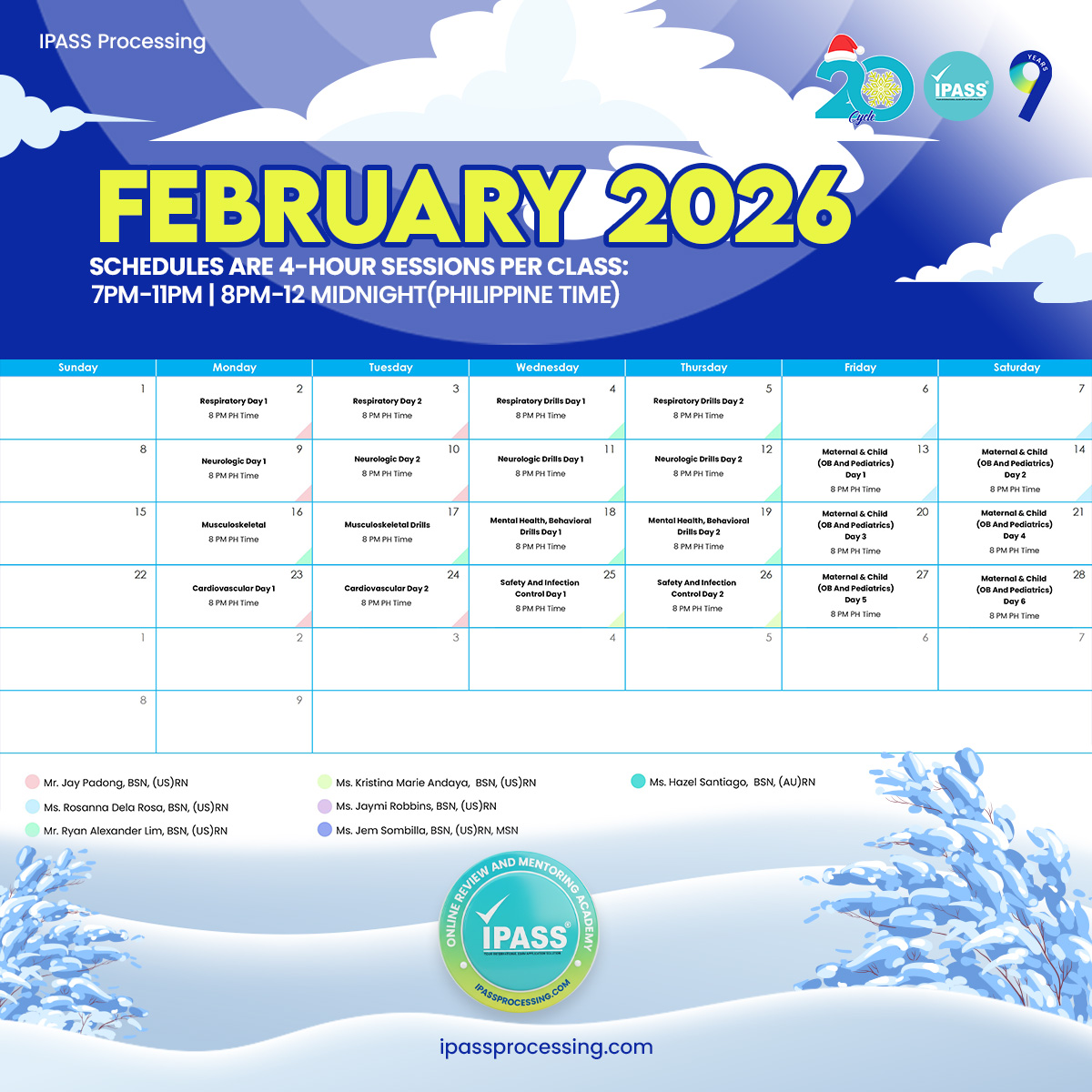
- February 1 – Respiratory (Day 1)
- February 2 – Respiratory (Day 2)
- February 3 – Respiratory Drills (Day 1)
- February 4 – Respiratory Drills (Day 2)
- February 8 – Neurologic (Day 1)
- February 9 – Neurologic (Day 2)
- February 10 – Neurologic Drills (Day 1)
- February 11 – Neurologic Drills (Day 2)
- February 12 – Maternal and Child (OB & Pediatrics) Day 1 – 8 PM TH Time
- February 13 – Maternal and Child (OB & Pediatrics) Day 2 – 8 PM TH Time
- February 14 – Maternal and Child (OB & Pediatrics) Day 3
- February 20 – Maternal and Child (OB & Pediatrics) Day 4
- February 21 – Maternal and Child (OB & Pediatrics) Day 5
- February 27 – Maternal and Child (OB & Pediatrics) Day 6
- February 28 – Maternal and Child (OB & Pediatrics) Day 7
- February 15 – Musculoskeletal (Day 1)
- February 16 – Musculoskeletal Drills
- February 22 – Cardiovascular (Day 1)
- February 23 – Cardiovascular (Day 2)
- February 24 – Safety and Infection Control (Day 1)
- February 25 – Safety and Infection Control (Day 2)
March 2026: Final Mastery and Intensive Drills Month
Preparing for Exam-Ready Performance
March is your final push toward exam readiness. We focus on advanced topics including Cardiovascular, Critical Care, Pain Management, Pharmacy, Trending Medications, Gastrointestinal, and Hematology Oncology. Each session combines lecture and drill, so you can practice under conditions that mirror the NCLEX itself. The month culminates with Pharmacology and Drug Calculation Drills, helping you enter your exam with confidence and precision. By the end of March, you’ll be equipped with the knowledge, skills, and strategies to succeed.

- March 2 – Cardiovascular Day 2
- March 3 – Cardiovascular Day 3
- March 4 – Maternal and Child (Ob and Pediatrics) Drills Day 1
- March 5 – Maternal and Child (Ob and Pediatrics) Drills Day 2
- March 6 – Cardiovascular Drills Day 1
- March 9 – Cardiovascular Day 5
- March 10 – Critical Care
- March 11 – Cardiovascular Drills Day 2
- March 12 – Cardiovascular Drills Day 3
- March 13 – Trending Topic Case Studies
- March 16 – Basic Care and Comfort Pain Management
- March 17 – Pharmacy and Drug Calculation
- March 18 – Trending Medications
- March 19 – Gastrointestinal Day 1
- March 20 – Gastrointestinal Day 2
- March 23 – Gastrointestinal Drills Day 1
- March 24 – Hematology Oncology Day 1
- March 25 – Hematology Oncology Day 2
- March 26 – Hematology Oncology Drills
- March 27 – Hematology Oncology Drills
- March 30 – Gastrointestinal Drills Day 2
- March 31 – Pharmacology and Drug Calculation Drills
At IPASS, we’re committed to walking with you every step of the way. Each month of your NCLEX review is carefully planned to ensure you build knowledge, strengthen clinical judgment, and gain the confidence to succeed on exam day. Let’s make this 20th Cycle your strongest yet!
Unlocking the 12-in-1 NCLEX Review Package for Cycle 20
Preparing for the NCLEX is more than just studying, it’s a journey that requires structure, guidance, and the right support system. As we launch the IPASS 20th Cycle, we’re excited to unveil our enhanced 14-in-1 NCLEX Review Package, a comprehensive bundle designed to give nursing graduates every advantage they need to succeed. Each component was thoughtfully crafted to address the real challenges that test-takers face, from mastering the Next-Gen format to managing exam-day anxiety. This is more than a review program, it’s a complete pathway toward becoming a confident and competent future USRN.

1. Unlimited Review Until You PASS
Our program ensures that you never feel rushed while preparing for the NCLEX. With unlimited access to review sessions, you can study at your own pace and revisit lessons as many times as needed until you confidently pass the exam.
2. Next-Gen NCLEX QBank Access
Experience realistic NGN-style learning with a comprehensive question bank designed to mirror the actual NCLEX format. Each case scenario helps you strengthen critical thinking and prepares you for the evolving demands of the exam.
3. Exam Assessments
Track your progress with structured assessments that pinpoint your strengths and areas for improvement. These evaluations help you focus on what truly matters so you can study smarter, not harder.
4. 1-on-1 Coaching Sessions
Receive personalized support from expert mentors who guide you through challenging topics and help you overcome learning barriers. These sessions are tailored to your weak areas to ensure consistent improvement.
5. Full-Length Mock Exams
Get the full NCLEX experience before exam day. Our simulated mock exams replicate real testing conditions, helping you build confidence, improve timing, and reduce anxiety.
6. Free Roadmap to NCLEX eBook
Access a digital NCLEX playbook filled with timelines, study strategies, and practical tips. This guide keeps you organized and ensures you’re always on track throughout your review journey.
7. Booster Coaching Classes (Final Coaching)
Strengthen your competencies in high-yield topics through intensive, expert-led booster classes. These final coaching sessions give you the push you need during the most crucial stage of your preparation.
8. Trending Topics Classes
Stay updated with the latest NCLEX trends, clinical scenarios, and high-yield concepts. These classes ensure you’re studying relevant content that reflects the current exam blueprint.
9. Anxiety Management Workshop + Exam Day Orientation
Learn how to manage test anxiety and face your Pearson VUE exam day with clarity and confidence. This workshop equips you with mental preparation techniques and practical reminders.
10. ₱500 OFF Printed NCLEX Roadmap Book
Students who prefer printed materials can take advantage of an exclusive discount on our physical NCLEX roadmap book. It’s a convenient companion for studying anytime, anywhere.
11. Exclusive NCLEX Processing Discount
Enjoy added value through discounted NCLEX processing services when bundled with your review. This helps you save time, reduce stress, and streamline your journey to becoming a USRN.
12. Performance Tracking & Test-Taking Strategy Tools
Monitor your readiness and progress through tools designed to enhance your test-taking strategies. These resources help you analyze performance trends and apply techniques that increase your likelihood of passing.
13. Readiness Assessments
Measure your overall exam preparedness through structured readiness evaluations designed to predict your probability of passing. These assessments help determine if you’re exam-ready or if you need focused reinforcement in specific content areas before scheduling your test.
14. Final Coaching
Master high-yield concepts through intensive final coaching sessions led by expert instructors. This last-phase preparation sharpens your clinical judgment, reinforces key strategies, and ensures you enter exam day confident, focused, and fully prepared.
Success in the NCLEX doesn’t happen by chance, it happens with preparation, commitment, and the right guidance. With the IPASS 20th Cycle and our 14-in-1 NCLEX Review Package, you’re not just signing up for a course; you’re joining a supportive community dedicated to helping you achieve your dream of becoming a licensed nurse abroad. Every tool, class, and resource is designed to bring you closer to passing with confidence.
If you’re ready to take the next step in your nursing career, this is the perfect time to begin.
Why Nurses Keep Choosing IPASS
Over the past cycles, IPASS has helped thousands of aspiring nurses build confidence and structure in their NCLEX journey.Many of our passers share how the step-by-step roadmap kept them focused, even when they felt overwhelmed and unsure where to start.

Students repeatedly highlight how the coaching sessions felt personal, supportive, and genuinely invested in their success.Those who struggled with the exam before often say the review finally made sense after joining IPASS. Our community-based learning environment allows students to feel guided, not just academically, but emotionally as well.The consistently high passing rates across multiple cycles reflect the strength of our approach and the dedication of our team.

Graduates often describe how the mock exams and practice questions helped them face the real test with confidence. Many nurses abroad today credit their career breakthrough to the foundation built during their IPASS review. With every new cycle, the growing number of testimonials reminds us of the life-changing impact of quality, structured preparation.And as we launch the 20th Cycle, these success stories continue to inspire the next generation of NCLEX passers to take the first step with confidence.
Kickstart Your NCLEX Prep with Our Holiday Discounts
To make this cycle even more special, IPASS is launching its exclusive Holiday Promo Offers, giving aspiring NCLEX passers a chance to begin their review journey with big savings. This limited-time offer makes quality NCLEX preparation more accessible, especially for those who want to start the new year with purpose and momentum.

Bundle Deal Highlights:
NCLEX Processing + Online Review Bundle
- NCLEX Plus Online Review (Full Payment): PHP 4,000 OFF regular price plus additional 20% off on your NCLEX Processing Service Fee.
- NCLEX Plus Online Review (Partial Payment): PHP 3,000 OFF regular price plus additional 20% off on your NCLEX Processing Service Fee.
NCLEX Online Review Only Options
- Full Payment Discount: PHP 2,800 OFF
- Installment Plan: PHP 2,200 OFF
Exclusive Discounts for Existing Clients
- NCLEX Plus Online Review (Full Payment): PHP 4,000 OFF regular price plus additional 15% off on your NCLEX Processing Service Fee.
- NCLEX Plus Online Review (Partial Payment): PHP 3,000 OFF regular price plus additional 10% off on your NCLEX Processing Service Fee.
To make the opportunity even more accessible, students can start their NCLEX review for as low as ₱5,000, allowing them to secure their slot now and plan their remaining payments with ease.
With over 81,143 successful clients and counting, these promos offer the perfect chance to join a community built on trust, results, and genuine support. This holiday season, investing in your NCLEX preparation could be the first step toward a life-changing career abroad at a price that is friendlier than ever
Building on Our Success: Your Next Step with IPASS
As we launch the 20th cycle, now is the perfect time to take charge of your NCLEX preparation and invest in a program that has guided thousands of nurses to success. With these holiday promos, starting your review has never been more accessible or rewarding.

The demand for nurses worldwide has never been higher. Countries like the United States, Canada, Australia, and the United Kingdom are actively seeking skilled professionals, creating life-changing career opportunities for those prepared to take the next step. By investing in your NCLEX preparation now, you position yourself to take advantage of this global demand and secure a career abroad.
If you want to see how far IPASS has come and how our strategies have evolved to support aspiring nurses, you can check out our recap of the 19th cycle here. It’s a great way to see the progress, results, and success stories that continue to shape our approach.
Frequently Asked Questions about 19th of IPASS Cycle NCLEX Review
1. What is the NCLEX pass rate for IPASS passers?
IPASS graduates consistently achieve NCLEX pass rates exceeding 95%, significantly higher than national averages. This success stems from the program’s comprehensive preparation methodology and individualized support for each student. The program tracks graduate outcomes carefully and continuously refines its curriculum based on performance data.
2. How long does it take to complete the IPASS Next-Gen NCLEX Review?
The IPASS Next-Gen NCLEX Review program is designed to be completed in approximately 12 weeks per cycle. However, with our “Unlimited Until You Pass” guarantee, you can take as much time as needed to fully master the content.
The program offers flexible scheduling options to accommodate different learning paces and life circumstances. As a result, it ensures you’re thoroughly prepared regardless of how long your individual journey takes.
3. Are there financing options available for the program?
Yes, IPASS offers various financing options including payment plans and discounts. Also, IPASS works with students to identify the most appropriate financing solutions for their individual circumstances.
4. Can I work while completing the IPASS program?
Many students successfully balance work responsibilities with program participation. The curriculum is designed to accommodate working professionals, with flexible scheduling options and online components. However, students should be prepared to dedicate significant time to their studies to ensure success.
5. What support is available if I don’t pass the NCLEX on my first attempt?
IPASS provides comprehensive support even if you don’t pass on your first attempt. Our “Unlimited Until You Pass” guarantee means you can continue attending review sessions and accessing study materials at no additional cost. You’ll receive personalized coaching to identify areas for improvement, additional practice questions targeting your weak points, and one-on-one sessions with instructors to develop a customized study plan for your retake.
Our success coaches will work with you to analyze your NCLEX performance report and create a focused preparation strategy, ensuring you’re better prepared for your next attempt.





Leave a Reply